From left to right: Cathay Cargo General Manager Commercial James Evans, Cathay General Manager Group Sustainability Grace Cheung, Cathay Director Cargo Dominic Perret, DSV Global Air Product Sustainability Vice President Achim Martinka, DSV Asia Pacific Sustainability Director Nina Barton, DSV Asia Pacific Air & Sea CEO Jakob Jeppesen
DSV and Cathay Cargo have entered into a landmark three-year partnership on sustainable aviation fuel (SAF), covering 4.5 million US gallons (13,155 tonnes) of SAF produced in Asia and is expected to support at least 45,000 tonnes of carbon dioxide equivalent emission reductions (CO2e) associated with air freight shipments. It marked the first long-term SAF partnership between the two companies.
Building on their long-standing commercial relationship and shared commitment in addressing emission associated with air freight, the agreement demonstrates DSV’s commitment to scale its decarbonisation efforts across its network, alongside Cathay Cargo’s ongoing efforts to support wider SAF adoption in Asia through collaboration with like-minded partners.
The agreement was announced at a ceremony hosted by Cathay Director Cargo Dominic Perret (left) and DSV Global Air Product Sustainability Vice President Achim Martinka (right)
Creating long-term demand for Asia SAF ecosystem
Cathay Cargo is the first airline from the region that DSV is partnering with to scale SAF across its Asia network. By sourcing all SAF under the partnership from Asia, the partnership aims to provide greater demand certainty and help increase the availability of SAF in the region.
“This partnership creates long-term demand for SAF produced in Asia. It supports the regional production and supply needed to scale its use,” says Stefan Krikken, Senior Vice President, Global Air Product.
SAF development in Asia is gaining momentum, with significant potential to scale further in the coming years. With air cargo demand expected to grow, accelerating SAF availability in the region will be critical to supporting the sector’s longer-term decarbonisation. Multi-year commitments like this can signal greater demand certainty, helping shape a favourable condition for the ecosystem to scale meaningfully.
“Scaling SAF requires collaboration across the aviation and logistics value chain, and this multi-year commitment reflects our shared vision to support its wider adoption. By working together to create sustained demand for SAF produced in Asia, we hope to contribute to the continued development of the SAF ecosystem in the region,” says Dominic Perret, Director Cargo at Cathay.
Transparent and verified emission reductions
The partnership is part of Cathay’s Corporate SAF Programme, where DSV has been a Diamond member. Verified emission reductions will be allocated to DSV independently of where SAF is physically used, supported by Cathay Cargo’s transparent and credible documentation of the reductions, covering the SAF journey from sourcing through to uplift.
SAF can reduce lifecycle carbon emissions compared with conventional jet fuel, but supply remains limited. Long-term agreements such as this could contribute to scaling up its use.


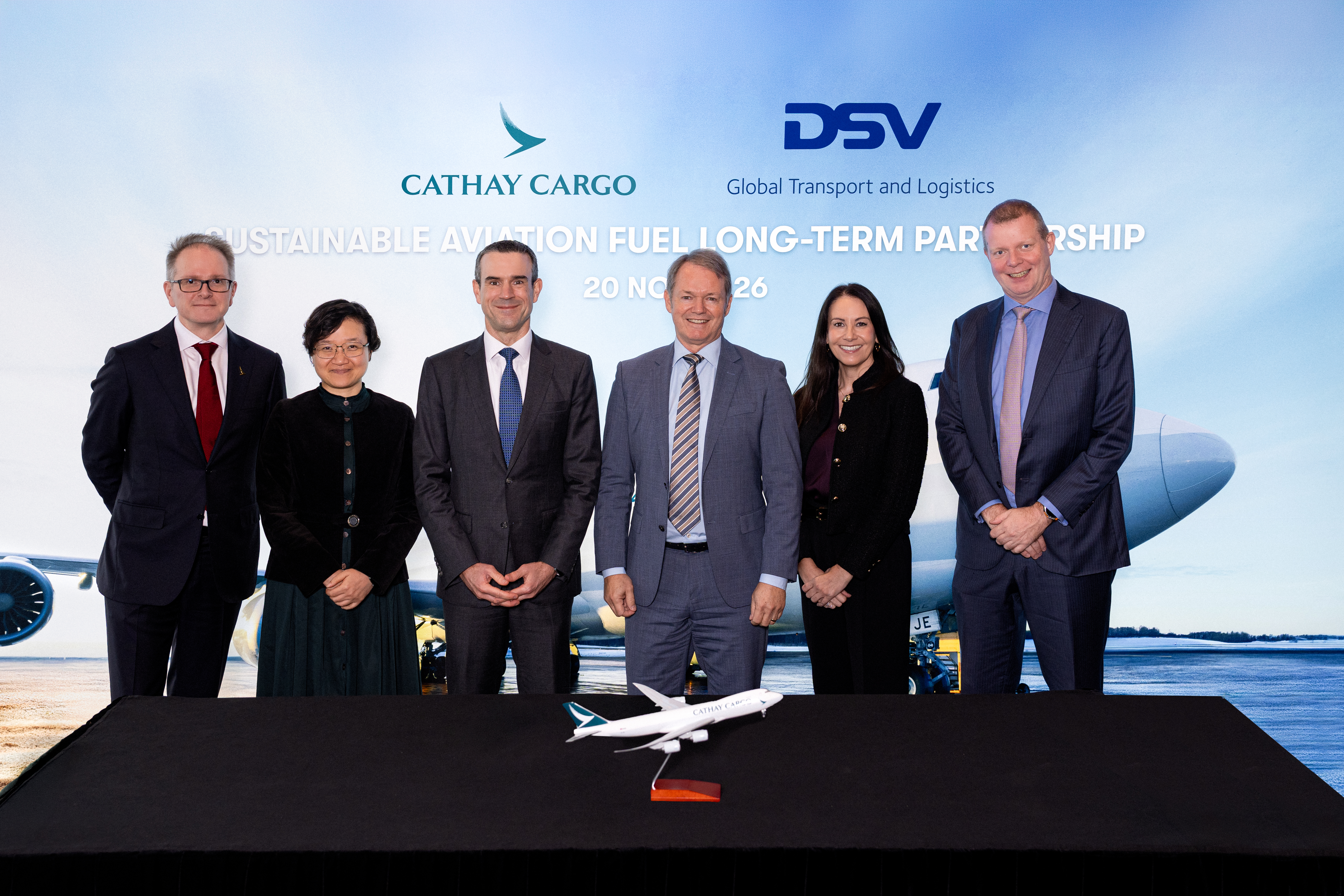




From left to right: Cathay Cargo General Manager Commercial James Evans, Cathay General Manager Group Sustainability Grace Cheung, Cathay Director Cargo Dominic Perret, DSV Global Air Product Sustainability Vice President Achim Martinka, DSV Asia Pacific Sustainability Director Nina Barton, DSV Asia Pacific Air & Sea CEO Jakob Jeppesen
DSV and Cathay Cargo have entered into a landmark three-year partnership on sustainable aviation fuel (SAF), covering 4.5 million US gallons (13,155 tonnes) of SAF produced in Asia and is expected to support at least 45,000 tonnes of carbon dioxide equivalent emission reductions (CO2e) associated with air freight shipments. It marked the first long-term SAF partnership between the two companies.
Building on their long-standing commercial relationship and shared commitment in addressing emission associated with air freight, the agreement demonstrates DSV’s commitment to scale its decarbonisation efforts across its network, alongside Cathay Cargo’s ongoing efforts to support wider SAF adoption in Asia through collaboration with like-minded partners.
Creating long-term demand for Asia SAF ecosystem
Cathay Cargo is the first airline from the region that DSV is partnering with to scale SAF across its Asia network. By sourcing all SAF under the partnership from Asia, the partnership aims to provide greater demand certainty and help increase the availability of SAF in the region.
“This partnership creates long-term demand for SAF produced in Asia. It supports the regional production and supply needed to scale its use,” says Stefan Krikken, Senior Vice President, Global Air Product.
SAF development in Asia is gaining momentum, with significant potential to scale further in the coming years. With air cargo demand expected to grow, accelerating SAF availability in the region will be critical to supporting the sector’s longer-term decarbonisation. Multi-year commitments like this can signal greater demand certainty, helping shape a favourable condition for the ecosystem to scale meaningfully.
“Scaling SAF requires collaboration across the aviation and logistics value chain, and this multi-year commitment reflects our shared vision to support its wider adoption. By working together to create sustained demand for SAF produced in Asia, we hope to contribute to the continued development of the SAF ecosystem in the region,” says Dominic Perret, Director Cargo at Cathay.
Transparent and verified emission reductions
The partnership is part of Cathay’s Corporate SAF Programme, where DSV has been a Diamond member. Verified emission reductions will be allocated to DSV independently of where SAF is physically used, supported by Cathay Cargo’s transparent and credible documentation of the reductions, covering the SAF journey from sourcing through to uplift.
SAF can reduce lifecycle carbon emissions compared with conventional jet fuel, but supply remains limited. Long-term agreements such as this could contribute to scaling up its use.
Share this:
Discover more from Great Travel Philippines
Subscribe to get the latest posts sent to your email.